USB-C charging
Amateur radio equipment works well with 11V-16V. But what about laptops and handphones?
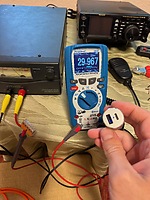
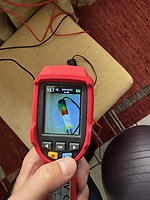
You can use a power inverter -- creating a sinusoid 230V AC using PWM and thus high efficiency, but only to convert it back into 20VDC? There must be a better way...
Indeed. I just bought a "mobile" USB-C charger, meaning its rated input power is 12VDC instead of 110-250VAC. It works well, but of course I had to do some measurements.
First of all, USB-C supports various "charging profiles", which is a fancy way of saying that the charged device can select the input voltage. You can typically choose between 5V, 12V and 20V, and I think 3.3V is also possible. Of course, this requires a DC to DC power converter. I don't have equipment that speaks the USB-C protocol (except my laptop, tablet, and handphone, of course, but they don't have connectors for a multimeter.
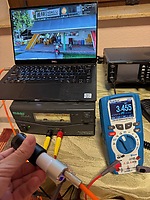
Curiously, the datasheet does not talk about the possible output voltages, nor does it mention a DC to DC converter. So let's find out some other way if there is one, or if this device simply passes through the 12V.
I am not 100% sure, but there are a few signs that there is indeed a DC to DC converter integrated. Firstly, I was able to hear clearly the high frequency sound the thing was making while in use. Especially when connected to a laptop whose battery wasn't charging: The abrupt power requirement changes due to changing CPU load puts additional stress on the device. Also, charging my laptop, the device used 4.9Amps. Supplied with 13.8 Volts, let's say 13Volts, taking into account the loss of the very thin wires, that's 13*4.9 == 63 Watts. Advertised are 60 Watts, so I'd say that's fine. Since the maximum output current advertised is 3 Amps, that means to achieve 60 Watts, an output voltage of 20V is required.
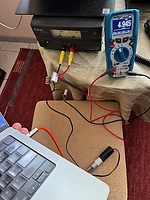
I think I'll like this little gadget.

Comments
Your comment
Your comment has been saved and will be subject to moderation before it is displayed on the website
(Note: Comments are moderated)