LSB, USB and FT8
Successful QSOs on the short wave bands can be difficult...
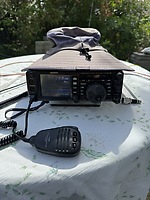
Despite this early success, I found working the short wave bands quite difficult:
First, with no exception, I was only ever able to hear one station. I know the theory behind this, of course. With class E, having only access to 10m and 15m, I had slim chances of doing a "more local" QSO. Those bands are primarily used for DX QSOs. Of course. But it is still confusing and always made me wonder if I had done something wrong. Reaching the Seychelles, I had confirmation that the antenna worked okay, but I still had the feeling that something might be wrong with it.
I did not receive a single response when calling CQ. My only chance for QSOs was to wait for someone else calling CQ and responding. I later learned that one of the reasons for this is Germany has "too" many amateur radio stations, so a German station calling CQ is not so interesting to many operators. Probably especially so, if the signal strength is rather weak.
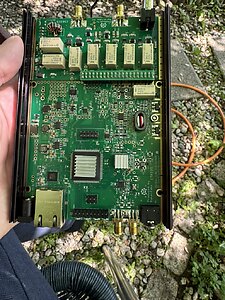
I wanted to use a dipole, and found a trap dipole that is suitable for 40m. The advantage of the trap dipole is its reduced length of 15m, compared to the normal length of 20m. I found the 40m band to be incredibly more workable than 10m, 15m and 20m. I had quite a few "local QSOs" in German, people responding immediately and giving me very good reports, S9 being the norm, sometimes S9+10 or even S9+20. Despite me using only 100 Watts.
That's why I really like the 40m band. Right now, it's my favorite band. I was never on 80m so far, I have to do some research about building a suitable antenna first.
While I was limited to 10m and 15m, I wanted to feel some success, at least. I started to use FT8, which is a natural fit for an SDR like the Hermes Lite 2. No fiddling with auxiliary cables. No rs232 and ancient protocols and speeds. No proprietary software. Unlike SSB, FT8 worked very well. I did get a lot of responses to my CQ calls, and I also successfully answered a lot of CQ calls. I like FT8. You can easily verify your setup, test how far you get, and you don't have to bother other OMs while doing so. That's one of the main advantages of FT8 to me. (The other being, of course, the S/N ratio FT8 can handle) Especially when you are new on the bands, you don't want to disturb others and/or annoy them with your weak signal, badly matched antenna, impatience, amplifiers suddenly emergency shutting down prematurely due to a mismatched antenna, etc. FT8 can handle all this with little to no annoyance to the other FT8 operators. That alone makes it an awesome mode for me. I really like FT8.
Once my antenna and equipment works well, I prefer talking via LSB or USB, though.

Comments
Your comment
Your comment has been saved and will be subject to moderation before it is displayed on the website
(Note: Comments are moderated)